JD Edwards Sustainability Framework: What It Is, Why It Matters, and How to Get Started
By iLearnERP
Sustainability is becoming an increasingly important part of business operations, and Oracle has responded by introducing the JD Edwards Sustainability Framework. Designed for EnterpriseOne users, the module helps organizations begin capturing sustainability data directly within their ERP. If you’ve heard about the JD Edwards Sustainability Module but aren’t quite sure what it does or whether it’s relevant to your organization, you’re not alone.
We sat down with Todd Nelson, Senior JD Edwards Consultant and Trainer at iLearnERP, who recently developed our Sustainability Framework training curriculum for EOne Academy, to get his perspective on what the module does, who it’s for, and why it’s worth understanding.
Why Oracle Introduced the JD Edwards Sustainability Framework
According to Todd, Oracle developed the Sustainability Framework in response to growing customer demand. Organizations wanted a way to capture sustainability data inside JD Edwards rather than relying on spreadsheets or disconnected systems.
Introduced in recent releases and expanded through Release 25 and Release 26, the framework provides a standardized way to collect sustainability information while fitting naturally into existing JD Edwards business processes.
What Does the JD Edwards Sustainability Module Actually Do?
One of the biggest misconceptions is that the Sustainability Framework generates sustainability reports. It doesn’t.
Instead, it captures and organizes sustainability-related data inside JD Edwards. That information can then be analyzed and reported using tools such as Oracle Enterprise Performance Management (EPM) or other reporting solutions.
Think of the Sustainability Framework as the data collection engine, not the reporting engine.
Understanding the Greenhouse Gas Protocol
The Sustainability Framework follows the Greenhouse Gas (GHG) Protocol, which organizes emissions into three categories:
Scope 1 – Direct emissions
Emissions produced directly by your organization, such as company vehicles, forklifts, or manufacturing equipment.
Scope 2 – Purchased energy
Emissions associated with electricity, heating, cooling, and other utilities your organization consumes.
Scope 3 – Supply chain emissions
Indirect emissions generated throughout your supply chain, from suppliers and transportation to the products and services your business purchases.
Todd says Scope 3 was the biggest surprise for him. “Even though your company isn’t directly creating those emissions, you’re still measuring the environmental impact of what you purchase.”
One Feature Todd Found Especially Valuable
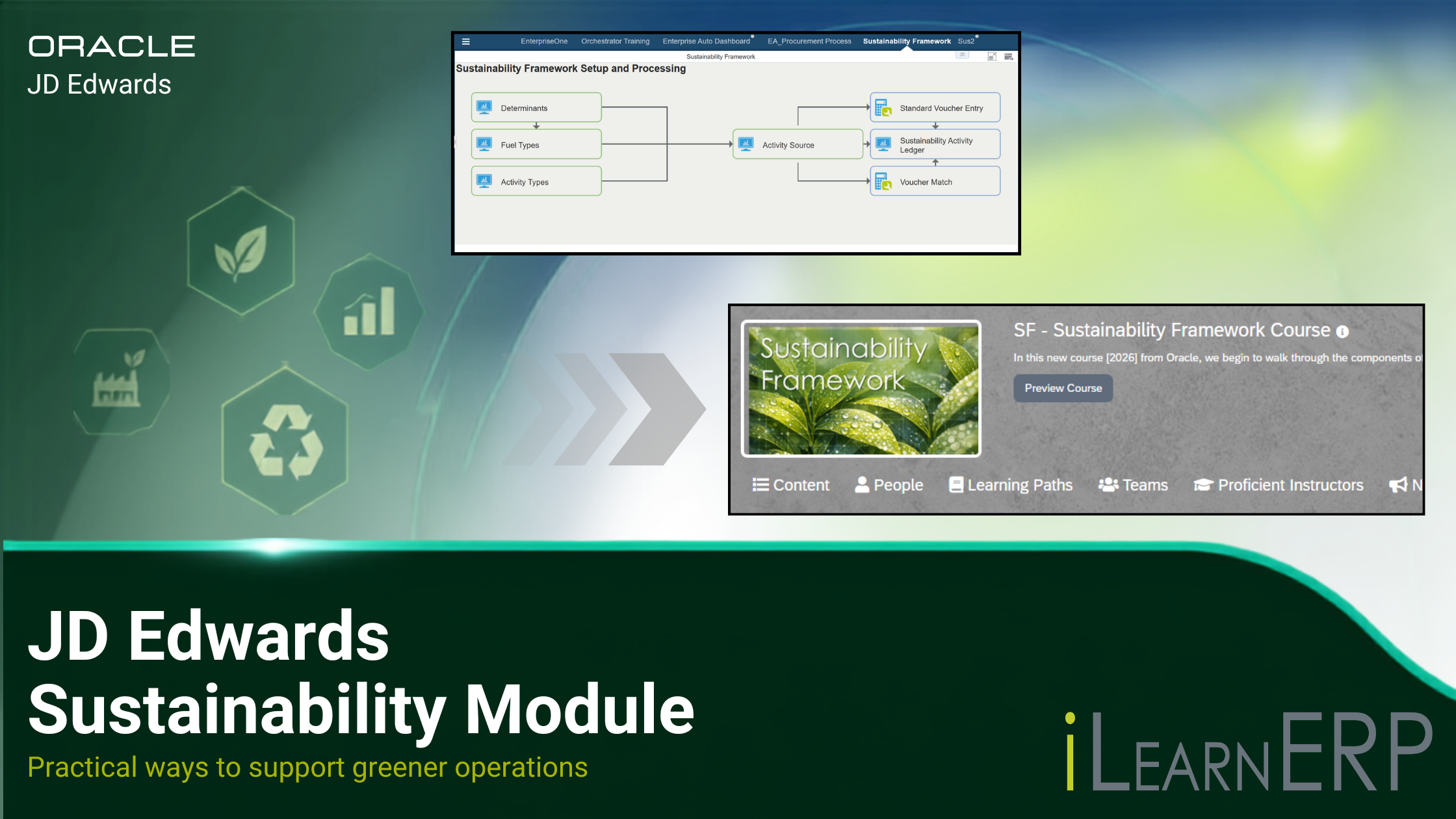
One feature Todd appreciated was how naturally Oracle integrated the Sustainability Framework into existing JD Edwards processes.
Rather than introducing a completely separate application, the module works alongside familiar functions like Standard Voucher Entry, Voucher Match, Accounts Payable, and the Sustainability Activity Ledger.
“From a user perspective, it’s actually a very easy tool to use.”
Before You Get Started…
Todd recommends understanding:
- The Greenhouse Gas Protocol
- Scope 1, Scope 2, and Scope 3 emissions
- How your organization will collect sustainability data
- Who owns that data
- How it will ultimately be reported
Understanding these concepts first makes implementation and user adoption much smoother.
Building Training for a Brand-New JD Edwards Module
Todd admits sustainability wasn’t an area he was deeply familiar with before taking on the project. Rather than seeing that as a disadvantage, he turned it into an advantage.
“The questions I had while learning the Sustainability Framework were probably the same questions our learners would have.”
That mindset shaped every course. Rather than overwhelming users with technical details, the training starts with the fundamentals, explains the business concepts first, and then walks through the functionality step by step. The new JD Edwards Sustainability Framework courses are now available in the EOne Academy, making it even easier for subscribers to explore new EnterpriseOne features through the same practical, hands-on learning approach.
Will Sustainability Become a Bigger Part of JD Edwards?
Will the Sustainability Framework become a major part of every JD Edwards implementation? Todd isn’t ready to make that prediction.
Oracle continues expanding the module, but AI and automation are currently receiving much of the attention across the ERP landscape.
What is clear is that organizations that begin learning the framework today will be better prepared if sustainability reporting becomes a larger business requirement in the future.
Learn the JD Edwards Sustainability Framework with Confidence
Whether your organization is preparing for ESG initiatives, exploring Oracle’s newest functionality, or simply wants to stay current with the latest JD Edwards enhancements, iLearnERP’s JD Edwards Sustainability Framework training can help.
Designed for business users and implementation teams alike, our courses simplify complex concepts and provide practical, hands-on instruction so your team can confidently understand and use the module.
Ready to get started? Contact iLearnERP at info@ilearnerp.com to learn more about our JD Edwards Sustainability Framework training.